2SC Rabbit Polyclonal Antibody
Key features and details
- Reactivity:Human
- Application:IHC
- Host:Rabbit
- Clonality:Polyclonal
- Target:2SC
-
Brand:

CAT.NO. : ARA6865
RMB Please choose
RMB Please choose
Size:
Trail, Bulk size or Custom requests Please contact us
*产品价格可能会有所调整,请以品牌方官网实时更新的价格为准,以确保准确性。
 Product Details
Background
Succination is a stable post-translational modification of cysteine residues, which modifies protein function or turnover in response to a changing intracellular redox environment. Succination occurs when the Krebs cycle intermediate, fumarate, reacts with cysteine yielding S-(2-succino)cysteine (2SC). A wide range of proteins are subject to succination, including enzymes, adipokines, cytoskeletal proteins and ER chaperones and succination has been shown to have roles in regulatory biology. An increase in succination of adipocyte proteins is seen in diabetes mellitus and results from nutrient excess derived mitochondrial stress. 2SC therefore serves as a biomarker of mitochondrial stress or dysfunction in chronic diseases, such as obesity, diabetes, and cancer.
Application
|
Application |
Dilution Ratio |
|
IHC |
1:50 - 1:200 |
Overview
|
Immunogen |
KLH conjugated S-(2-succinyl)-cysteine |
|
Host |
Rabbit Polyclonal IgG |
|
Presentation |
Liquid in PBS containing 0.01% Sodium Azide and 1% Trehalose |
|
Cross Reactivity |
Succinated proteins |
|
Storage Conditions |
The product should be stored at -20°C. It is recommended to aliquot into working volumes to avoid multiple freeze/thaw cycles. |
|
Preparation Method |
Crude antiserum was purified by affinity chromatography using S-(2-succinyl)-cysteine specific antigen |
Data
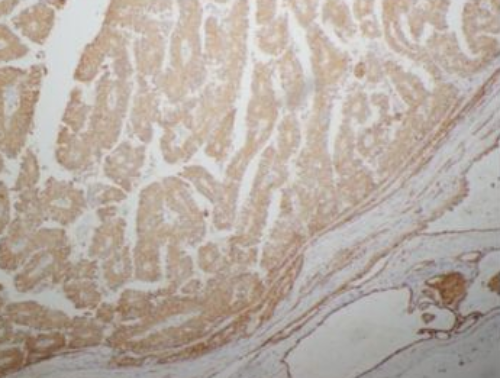
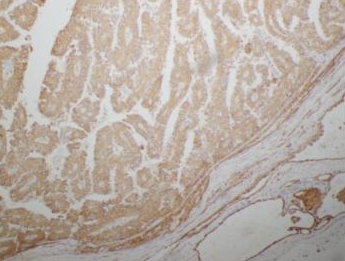
Immunohistochemical staining of hereditary leiomyomatosis and renal cell carcinoma(HLRCC) sections using 2SC Rabbit Polyclonal Antibody.
Storage
Store at 4°C short term. For long term storage, store at -20°C, avoiding freeze/thaw cycles.
Research Use Only
For Research Use Only. Not for use in diagnostic procedures.
New Products