CD289 Rabbit Polyclonal Antibody
Key features and details
- Reactivity:Human, Mouse, Rat
- Application:WB
- Host:Rabbit
- Clonality:polyclonal
- Target:CD289
-
Brand:

CAT.NO. : ARA6487
RMB Please choose
RMB Please choose
*产品价格可能会有所调整,请以品牌方官网实时更新的价格为准,以确保准确性。
 Product Details
Background
Gastrin-releasing peptide (GRP) regulates numerous functions of the gastrointestinal and central nervous systems, including release of gastrointestinal hormones, smooth muscle cell contraction, and epithelial cell proliferation and is a potent mitogen for neoplastic tissues. The effects of GRP are mediated through the gastrin-releasing peptide receptor. This receptor is a glycosylated, 7-transmembrane G-protein coupled receptor that activates the phospholipase C signaling pathway. The receptor is aberrantly expressed in numerous cancers such as those of the lung, colon, and prostate. An individual with autism and multiple exostoses was found to have a balanced translocation between chromosome 8 and a chromosome X breakpoint located within the gastrin-releasing peptide receptor gene.
Application
|
Application |
Dilution Ratio |
|
WB |
1:500 - 1:2000 |
Overview
|
Immunogen |
Recombinant full length protein of human GRPR |
|
Purification Method |
The antibody was purified by immunogen affinity chromatography. |
|
Clonality |
Polyclonal |
|
Product Form |
Liquid in 0.42% Potassium phosphate, 0.87% Sodium chloride, pH 7.3, 30% glycerol, and 0.01% sodium azide. |
|
Gene Name |
GRPR |
|
Alternative Names |
Gastrin-releasing peptide receptor; GRP-R; GRP-preferring bombesin receptor |
|
Human Gene ID |
2925 |
|
Mouse Gene ID |
14829 |
|
Rat Gene ID |
24938 |
|
Human Protein ID |
P30550 |
|
Mouse Protein ID |
P21729 |
|
Rat Protein ID |
P52500 |
Data
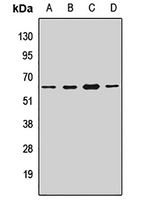
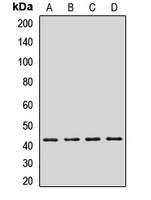
Western blot analysis of GRPR expression in A549 (A), MCF7 (B), mouse brain (C), rat brain (D) whole cell lysates. (Predicted band size: 43 kD; Observed band size: 43 kD)
Storage
Store at 4°C short term. For long term storage, store at -20°C, avoiding freeze/thaw cycles.
Research Use Only
For Research Use Only. Not for use in diagnostic procedures.
New Products