Human GITR/TNFRSF18 ELISA Kit

Key features and details

  • Target: GITR/TNFRSF18
  • Reactivity: Human
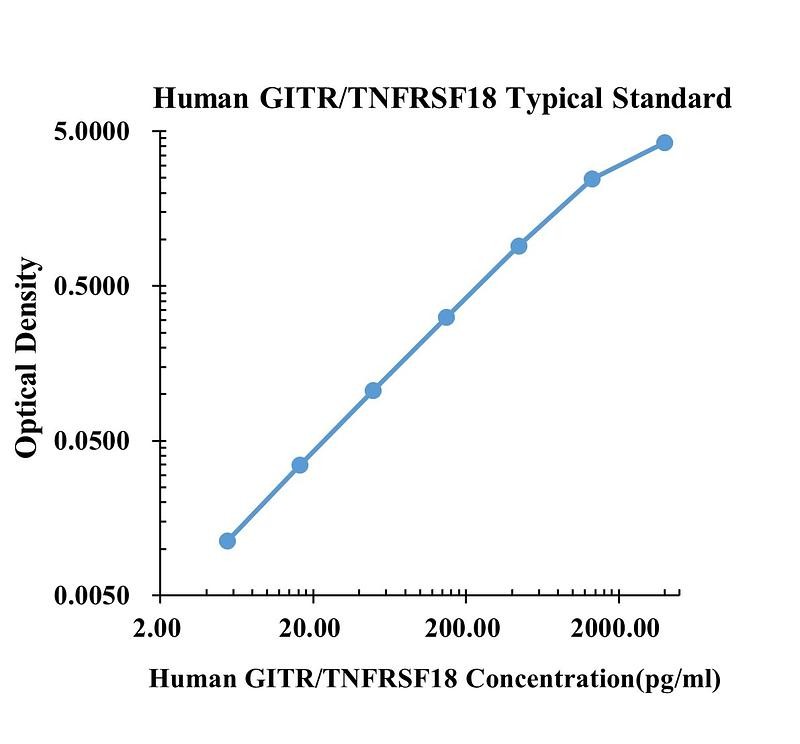
  • Range: 5.49-4000 pg/ml
  • Sensitivity: 0.07 pg/ml (50 μl);1.20 pg/ml (10 μl)
  • Assay type Sandwich Elisa
  • Storage at 2 ~8°C
  • Brand:
CAT.NO. : AEH0095
US$ Please choose
US$ Please choose
Size:
Trail, Bulk size or Custom requests Please contact us
Product Details
Background
GITR (glucocorticoid-induced tumor necrosis factor receptor, also named AITR, activation-inducible TNF R family member), is a 228 amino acid (aa) type I transmembrane protein belonging to the TNF R family and has been designated TNFRSF18. The GITR cytoplasmic domain has striking homology with the cytoplasmic domain of 4-1BB and CD27. Human GITR shares 55% homology with murine GITR. GITR is expressed at low levels in peripheral blood T cells, bone marrow, thymus, spleen, and lymph nodes. In contrast to mouse GITR, expression of human GITR is not induced by treatment with dexamethasone, but is up-regulated by antigen stimulation or by treatment with anti-CD3 plus anti-CD28, or PMA plus ionomycin. Human GITR ligand was identified from human umbilical vein endothelial cells and is a 177 aa polypeptide belonging to the TNF superfamily (TNFSF18). Ligation of GITR can activate NF-kappa B through TRAF2, and protect T cells from TCR activation-induced cell death. It has been proposed that GITR ligand and GITR may modulate T lymphocyte functions.
Overview

Sensitivity

0.07 pg/ml (50 μl);1.20 pg/ml (10 μl)

Standard Curve Range

5.49-4000 pg/ml

Standard Curve Gradient

7 Points/3 Folds

Number of Incubations

2

Detectable Sample

Liquid phase sample of soluble substances. For example: serum, plasma, cell culture supernatant, tissue grinding liquid, etc.

Sample Volume

50 μl/10 μl

Type

Fully Ready-to-Use

Operation Duration

120min

Alternative Names

Activation-inducible TNFR family receptor, Glucocorticoid-induced TNFR-related protein

Gene Symbol

TNFRSF18, AITR, GITR

Entrez Gene

8784 (Human)

SwissProt

Q9Y5U5 (Human)

*AREX continuously optimizes our products. Webpage content may not reflect the latest updates. For inquiries, please contact info@arexbio.com or your local distributor.
Data

<table><tr><td>pg/ml</td><td>O.D.1</td><td>O.D.2</td><td>Average</td><td>Corrected</td></tr><tr><td>0.00</td><td>0.0145</td><td>0.0146</td><td>0.0146</td><td></td></tr><tr><td>5.49</td><td>0.0260</td><td>0.0256</td><td>0.0258</td><td>0.0113</td></tr><tr><td>16.46</td><td>0.0492</td><td>0.0497</td><td>0.0495</td><td>0.0349</td></tr><tr><td>49.38</td><td>0.1206</td><td>0.1200</td><td>0.1203</td><td>0.1058</td></tr><tr><td>148.15</td><td>0.3372</td><td>0.3175</td><td>0.3274</td><td>0.3128</td></tr><tr><td>444.44</td><td>0.9332</td><td>0.9130</td><td>0.9231</td><td>0.9086</td></tr><tr><td>1333.33</td><td>2.4945</td><td>2.4639</td><td>2.4792</td><td>2.4647</td></tr><tr><td>4000.00</td><td>4.1397</td><td>4.2936</td><td>4.2167</td><td>4.2021</td></tr></table>

Precision
Intra-assay Precision Inter-assay Precision
Sample Number S1 S2 S3 S1 S2 S3
22 22 22 6 6 6
Average(pg/ml) 1410.0 535.3 111.0 1556.0 680.1 136.7
Standard Deviation 55.5 10.1 2.4 102.5 32.1 9.1
Coefficient of Variation(%) 3.9 1.9 2.2 6.6 4.7 6.7

Intra-assay Precision (Precision within an assay) Three samples of known concentration were tested Twenty-two times on one plate to assess intra-assay precision.

Inter-assay Precision (Precision between assays) Three samples of known concentration were tested six times on one plate to assess intra-assay precision.

Spike Recovery

The spike recovery was evaluated by spiking 3 levels of human GITR/TNFRSF18 into health human serum sample. The un-spiked serum was used as blank in this experiment. The recovery ranged from 84% to 111% with an overall mean recovery of 98%.

Sample Values
Sample Matrix Sample Evaluated Range (pg/ml) Detectable (%) Mean of Detectable (pg/ml)
Serum30n.d.-1.19750.47
Storage
Store components at 4°C or -20°C. Keep microplate wells sealed in a dry bag with desiccants. Do not expose test reagents to heat, sun or strong light during storage and usage. Please refer to the product user manual for detail temperatures of the components.
Note
For Research Use Only. Not for diagnostic, therapeutics, prophylactic or in vivo use.
FAQs
What is the principle of these ELISA kits?
The kits are based on the sandwich or competitive ELISA principle, using specific antibodies and enzyme-conjugated detection for quantitative measurement of the target analyte.
What sample types can be used with the ELISA kits?
Suitable samples typically include serum, plasma, cell culture supernatant, tissue homogenates, and other biological fluids. Please check the specific Datasheet for recommended sample types.
How should the kits be stored and what is the shelf life?
Store components at 4°C or -20°C. Keep microplate wells sealed in a dry bag with desiccants. Do not expose test reagents to heat, sun or strong light during storage and usage. Please refer to the product user manual for detail temperatures of the components.
What is the precision and reproducibility of the kits?
The kits are optimized for good intra- and inter-assay precision when performed according to the protocol. Coefficient of variation (CV) values are generally low.
Do you provide technical support or troubleshooting guidance?
Yes. We provide detailed Datasheets, Certificates of Analysis (CoA), and technical support to help with assay performance and troubleshooting.
New Products
Get in touch with AREX
Name:*
Tel/Phone:*
Company:*
Email:*
Inquiry:
Captcha*
Submitting your email information means that you are willing to receive email information from AREX regarding technology, applications, products, and events. By clicking on the 'unsubscribe' button in the email or by contacting info@arexbio.com You can unsubscribe at any time by sending an email. Regarding your data usage information, please refer to our privacy policy.
© AREX 2024. All Rights Reserved. | 浙ICP备2024113709号-3 Sitemap