

Human LIF ARExSet® antibody pair for ELISA
 Instruction
Key features and details
- Target:
- Reactivity:
- Sample Volume:
- Range:
- Operation Duration:
-
Brand:

 Product Details
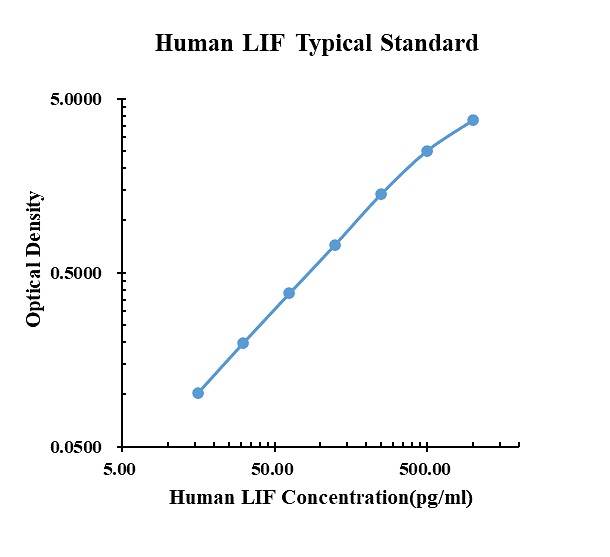
Standard Curve Range | 15.63 pg/ml -1000 pg/ml |
Standard Curve Gradient | 7 Points/3 Folds |
Number of Incubations | 2 |
Detectable Sample | Liquid phase sample of soluble substances. For example: serum, plasma, cell culture supernatant, tissue grinding liquid, etc. |
Sample Volume | 50 μl |
Type | Not Ready-to-Use |
Operation Duration | 120min |
Alternative Names | Differentiation-stimulating factor, Melanoma-derived LPL inhibitor |
Gene Symbol | LIF, HILDA |
Entrez Gene | 3976 (Human) |
SwissProt | P15018 (Human) |
<table><tr><td>pg/ml</td><td>O.D.1</td><td>O.D.2</td><td>Average</td><td>Corrected</td></tr><tr><td>0.00</td><td>0.0181</td><td>0.0168</td><td>0.0175</td><td></td></tr><tr><td>15.63</td><td>0.1195</td><td>0.1172</td><td>0.1184</td><td>0.1014</td></tr><tr><td>31.25</td><td>0.2163</td><td>0.2191</td><td>0.2177</td><td>0.1982</td></tr><tr><td>62.50</td><td>0.3981</td><td>0.3917</td><td>0.3949</td><td>0.3800</td></tr><tr><td>125.00</td><td>0.7436</td><td>0.7410</td><td>0.7423</td><td>0.7255</td></tr><tr><td>250.00</td><td>1.4300</td><td>1.3890</td><td>1.4095</td><td>1.4119</td></tr><tr><td>500.00</td><td>2.5240</td><td>2.4130</td><td>2.4685</td><td>2.5059</td></tr><tr><td>1000.00</td><td>3.7730</td><td>3.7080</td><td>3.7405</td><td>3.7549</td></tr></table>
• Development protocols are provided to guide further assay optimization
• Assay can be customized to your specific needs
• Economical alternative to complete kits
• Detection Antibody
• Recombinant Standard
• Streptavidin conjugated to horseradish-peroxidase (Streptavidin-HRP)
• 96 well microplates: AREX Biosciences, Catalog # DSEP01.
• Plate Sealers: AREX Biosciences, Catalog # DSSF01.
• Coating Buffer: 137 mM NaCl, 2.7 mM KCl, 8.1 mM Na2HPO4, 1.5 mM KH2PO4, pH 7.2-7.4, 0.2 μm filtered. AREX Biosciences, Catalog # DSCB01.
• Blocking Buffer: AREX Biosciences, Catalog # DSBB01.
• Wash Buffer: 0.05% Tween 20 in PBS, pH 7.2-7.4. AREX Biosciences, Catalog # DSWB01.
• Assay Buffer: 0.5%BSA,0.05%Tween20,PBS Solution.AREX Biosciences, Catalog # DSAB01
• Substrate Solution: Tetramethylbenzidine. AREX Biosciences, Catalog # DSTS01.
• Stop Solution: 0.5mol/L H2SO4. AREX Biosciences, Catalog # DSSS01.
FAQs
 New Products