anti-ITCH / AIF4 antibody
Key features and details
- 产品描述:
- 反应物种:
- 应用:
- 宿主:
- 克隆:
- 同位型:
- 靶点名称:
- 抗原物种:
- 抗原:
-
Brand:

CAT.NO. : ARG43032
US$ Please choose
US$ Please choose
Size:
Trail, Bulk size or Custom requests Please contact us
 Product Details
概述
| 产品描述 | Rabbit Polyclonal antibody recognizes ITCH / AIF4 |
|---|---|
| 反应物种 | Hu, Ms, Rat |
| 应用 | WB |
| 宿主 | Rabbit |
| 克隆 | Polyclonal |
| 同位型 | IgG |
| 靶点名称 | ITCH / AIF4 |
| 抗原物种 | Human |
| 抗原 | Synthetic peptide within aa. 50-150 of Human ITCH / AIF4 (NP_001244066.1). |
| 偶联标记 | Un-conjugated |
| 別名 | EC 6.3.2.-; Itch; Atrophin-1-interacting protein 4; ADMFD; E3 ubiquitin-protein ligase Itchy homolog; NFE2-associated polypeptide 1; AIF4; AIP4; NAPP1 |
应用说明
| 应用建议 |
| ||||
|---|---|---|---|---|---|
| 应用说明 | * The dilutions indicate recommended starting dilutions and the optimal dilutions or concentrations should be determined by the scientist. | ||||
| 阳性对照 | THP-1 |
属性
| 形式 | Liquid |
|---|---|
| 纯化 | Affinity purified. |
| 缓冲液 | PBS (pH 7.3), 0.02% Sodium azide and 50% Glycerol. |
| 抗菌剂 | 0.02% Sodium azide |
| 稳定剂 | 50% Glycerol |
| 存放说明 | For continuous use, store undiluted antibody at 2-8°C for up to a week. For long-term storage, aliquot and store at -20°C. Storage in frost free freezers is not recommended. Avoid repeated freeze/thaw cycles. Suggest spin the vial prior to opening. The antibody solution should be gently mixed before use. |
| 注意事项 | For laboratory research only, not for drug, diagnostic or other use. |
生物信息
| 数据库连接 | Swiss-port # Q8C863 Mouse E3 ubiquitin-protein ligase Itchy Swiss-port # Q96J02 Human E3 ubiquitin-protein ligase Itchy homolog |
|---|---|
| 基因名称 | ITCH |
| 全名 | itchy E3 ubiquitin protein ligase |
| 背景介绍 | This gene encodes a member of the Nedd4 family of HECT domain E3 ubiquitin ligases. HECT domain E3 ubiquitin ligases transfer ubiquitin from E2 ubiquitin-conjugating enzymes to protein substrates, thus targeting specific proteins for lysosomal degradation. The encoded protein plays a role in multiple cellular processes including erythroid and lymphoid cell differentiation and the regulation of immune responses. Mutations in this gene are a cause of syndromic multisystem autoimmune disease. Alternatively spliced transcript variants encoding multiple isoforms have been observed for this gene. [provided by RefSeq, Mar 2012] |
| 生物功能 | Acts as an E3 ubiquitin-protein ligase which accepts ubiquitin from an E2 ubiquitin-conjugating enzyme in the form of a thioester and then directly transfers the ubiquitin to targeted substrates (PubMed:14602072, PubMed:17028573, PubMed:16387660, PubMed:18718448, PubMed:18718449, PubMed:11046148, PubMed:19592251, PubMed:19116316, PubMed:19881509, PubMed:20491914, PubMed:20392206, PubMed:20068034, PubMed:23146885, PubMed:24790097, PubMed:25631046). Catalyzes 'Lys-29'-, 'Lys-48'- and 'Lys-63'-linked ubiquitin conjugation (PubMed:17028573, PubMed:18718448, PubMed:19131965, PubMed:19881509). Involved in the control of inflammatory signaling pathways (PubMed:19131965). Essential component of a ubiquitin-editing protein complex, comprising also TNFAIP3, TAX1BP1 and RNF11, that ensures the transient nature of inflammatory signaling pathways (PubMed:19131965). Promotes the association of the complex after TNF stimulation (PubMed:19131965). Once the complex is formed, TNFAIP3 deubiquitinates 'Lys-63' polyubiquitin chains on RIPK1 and catalyzes the formation of 'Lys-48'-polyubiquitin chains (PubMed:19131965). This leads to RIPK1 proteasomal degradation and consequently termination of the TNF- or LPS-mediated activation of NFKB1 (PubMed:19131965). Ubiquitinates RIPK2 by 'Lys-63'-linked conjugation and influences NOD2-dependent signal transduction pathways (PubMed:19592251). Regulates the transcriptional activity of several transcription factors, and probably plays an important role in the regulation of immune response (PubMed:18718448, PubMed:20491914). Ubiquitinates NFE2 by 'Lys-63' linkages and is implicated in the control of the development of hematopoietic lineages (PubMed:18718448). Mediates JUN ubiquitination and degradation (By similarity). Mediates JUNB ubiquitination and degradation (PubMed:16387660). Critical regulator of type 2 helper T (Th2) cell cytokine production by inducing JUNB ubiquitination and degradation (By similarity). Involved in the negative regulation of MAVS-dependent cellular antiviral responses (PubMed:19881509). Ubiquitinates MAVS through 'Lys-48'-linked conjugation resulting in MAVS proteasomal degradation (PubMed:19881509). Following ligand stimulation, regulates sorting of Wnt receptor FZD4 to the degradative endocytic pathway probably by modulating PI42KA activity (PubMed:23146885). Ubiquitinates PI4K2A and negatively regulates its catalytic activity (PubMed:23146885). Ubiquitinates chemokine receptor CXCR4 and regulates sorting of CXCR4 to the degradative endocytic pathway following ligand stimulation by ubiquitinating endosomal sorting complex required for transport ESCRT-0 components HGS and STAM (PubMed:14602072, PubMed:23146885). Targets DTX1 for lysosomal degradation and controls NOTCH1 degradation, in the absence of ligand, through 'Lys-29'-linked polyubiquitination (PubMed:17028573, PubMed:18628966, PubMed:23886940). Ubiquitinates SNX9 (PubMed:20491914). Ubiquitinates MAP3K7 through 'Lys-48'-linked conjugation (By similarity). Involved in the regulation of apoptosis and reactive oxygen species levels through the ubiquitination and proteasomal degradation of TXNIP (PubMed:20068034). Mediates the antiapoptotic activity of epidermal growth factor through the ubiquitination and proteasomal degradation of p15 BID (PubMed:20392206). Ubiquitinates BRAT1 and this ubiquitination is enhanced in the presence of NDFIP1 (PubMed:25631046). [UniProt] |
| 细胞定位 | Cell membrane. Cytoplasm. Nucleus. Early endosome membrane. Endosome membrane. Note=May be recruited to exosomes by NDFIP1 (PubMed:18819914). Localizes to plasma membrane upon CXCL12 stimulation where it co-localizes with CXCL4 (PubMed:14602072). Localization to early endosomes is increased upon CXCL12 stimulation where it co-localizes with DTX3L and CXCL4 (PubMed:24790097). [UniProt] |
| 预测分子量 | 103 kDa |
| 翻译后修饰 | On T-cell activation, phosphorylation by the JNK cascade on serine and threonine residues surrounding the PRR domain accelerates the ubiquitination and degradation of JUN and JUNB. The increased ITCH catalytic activity due to phosphorylation by JNK1 may occur due to a conformational change disrupting the interaction between the PRR/WW motifs domain and the HECT domain and, thus exposing the HECT domain (By similarity). Phosphorylation by FYN reduces interaction with JUNB and negatively controls JUN ubiquitination and degradation. Ubiquitinated; autopolyubiquitination with 'Lys-63' linkages which does not lead to protein degradation. [UniProt] |
检测图片 (1)
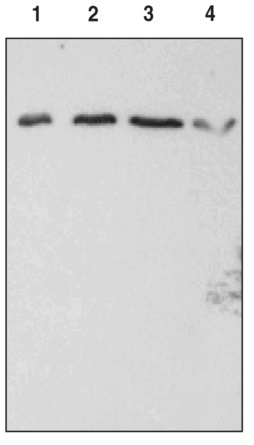
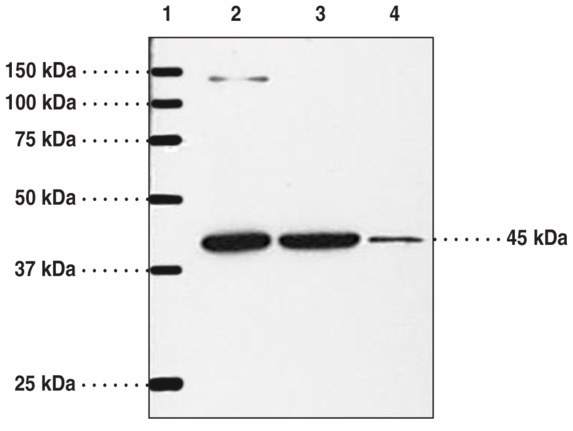
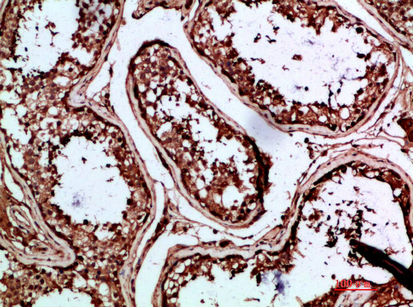
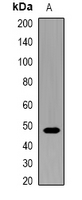
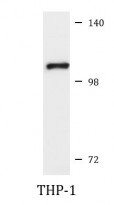
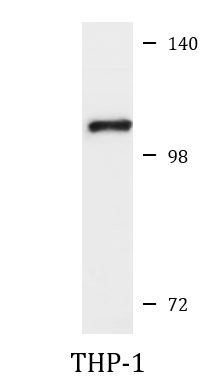
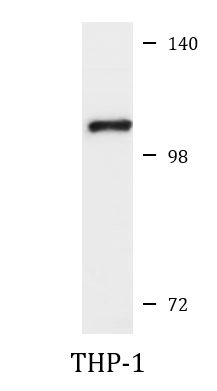
ARG43032 anti-ITCH / AIF4 antibody WB image
Western blot: 25 µg of THP-1 cell lysate stained with ARG43032 anti-ITCH / AIF4 antibody at 1:1000 dilution.
 New Products