CD289 Rabbit Polyclonal Antibody
Key features and details
- Reactivity:Human, Mouse, Rat
- Application:WB, IHC
- Host:Rabbit
- Clonality:polyclonal
- Target:CD289
-
Brand:

CAT.NO. : ARA6489
RMB Please choose
RMB Please choose
 Product Details
Background
CD289, the Toll-like Receptors (TLR) are a family of human receptors that share homology with the Drosophila Toll Receptors, which are involved in mediating dorsoventral polarization in developing Drosophila embryos and participate in host immunity. The TLR family members are characterized by a highly conserved Toll homology (TH) domain, which is essential for Toll-induced signal transductions. TLRs are type I transmembrane receptors that contain an extracellular domain consisting of several leucine-rich regions and a single cytoplasmic Toll/IL-1R like domain. Three TLR family members, TLR7, TLR8 and TLR9, belong to a subfamily of TLRs which are differentially expressed. TLR7 is expressed in lung, placenta and spleen. TLR8 is expressed in lung and peripheral blood leukocytes, and TLR9 is predominantly expressed in spleen, lymph nodes, bone marrow and peripheral blood leukocytes. TLR7, TLR8 and TLR9 stimulate the NFκB signaling pathway, suggesting that they play a role in the immune response.
Application
|
Application |
Dilution Ratio |
|
WB |
1:500 - 1:2000 |
|
IHC |
1:50 - 1:200 |
Overview
|
Immunogen |
KLH-conjugated synthetic peptide encompassing a sequence within the center region of human CD289. The exact sequence is proprietary. |
|
Purification Method |
The antibody was purified by immunogen affinity chromatography. |
|
Clonality |
Polyclonal |
|
Product Form |
Liquid in 0.42% Potassium phosphate, 0.87% Sodium chloride, pH 7.3, 30% glycerol, and 0.01% sodium azide. |
|
Gene Name |
TLR9 |
|
Alternative Names |
Toll-like receptor 9; CD289 |
|
Human Gene ID |
54106 |
|
Mouse Gene ID |
81897 |
|
Human Protein ID |
Q9NR96 |
|
Mouse Protein ID |
Q9EQU3 |
Data
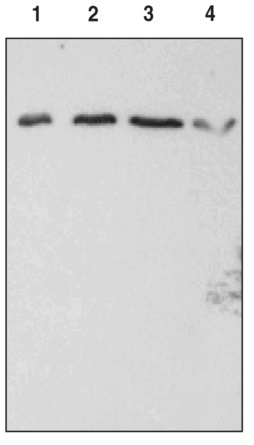
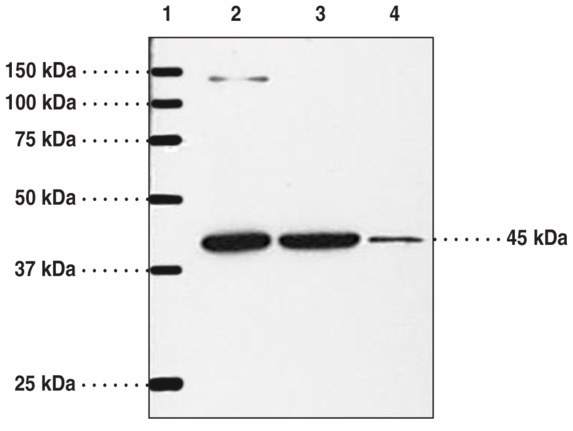
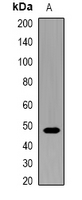
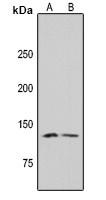
Western blot analysis of CD289 expression in mouse spleen (A), rat spleen (B) whole cell lysates. (Predicted band size: 109; 114; 115; 118 kD; Observed band size: 135 kD)
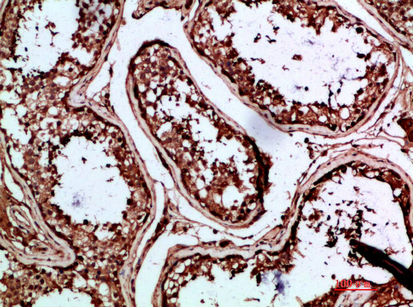
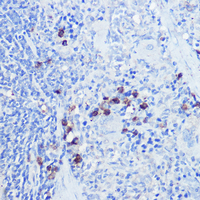
Immunohistochemical analysis of CD289 staining in rat spleen formalin fixed paraffin embedded tissue section. The section was pre-treated using heat mediated antigen retrieval with sodium citrate buffer (pH 6.0). The section was then incubated with the antibody at room temperature and detected using an HRP conjugated compact polymer system. DAB was used as the chromogen. The section was then counterstained with haematoxylin and mounted with DPX.
Storage
Store at 4°C short term. For long term storage, store at -20°C, avoiding freeze/thaw cycles.
Research Use Only
For Research Use Only. Not for use in diagnostic procedures.
New Products