Glutamine Synthetase Mouse Monoclonal Antibody(ARM619)
Key features and details
- Target:
- Clone ID:
- Host:
- Species Cross-reactivity:
- Applications:
- Dilution:
- Clonality:
-
Brand:

CAT.NO. : ARM6910
US$ Please choose
US$ Please choose
Size:
Trail, Bulk size or Custom requests Please contact us
 Product Details
Background
Glutamine Synthetase (GS-6 or GS) catalyzes the conversion of glutamate and ammonia to glutamine in the liver, and is expressed in pericentral hepatocytes, but not in periportal hepatocytes or in the mid-zonal hepatocytes. Anti-Glutamine Synthetase is useful in some hepatocellular carcinomas and many high grade dysplastic nodules, and therefore may be useful in recognizing these cases. A panel of antibodies against HSP70 (heat shock protein 70), GPC3, and glutamine synthetase is useful for differentiating dysplastic from early malignant hepatocellular nodules in cirrhosis. GS staining of hepatocellular lesions is useful for the differential diagnosis of focal nodular hyperplasia (FNH), hepatic adenoma (HCA), dysplastic nodules, and low grade hepatocellular carcinoma. FNH produces a “map-like” pattern when stained with Anti-Glutamine Synthetase. Conversely, HCA can stain negatively, produce border staining, or stain around the tumour veins.
Application
|
Application |
Dilution Ratio |
|
IHC |
1:25 - 1:200 |
Overview
|
Molecular Weight |
42,064 Da |
|
Chromosome Location |
Chromosome: 1; NC_000001.10 (182350839..182361341, complement). Location: 1q31 |
|
3D Structure |
ModBase 3D Structure for P15104 |
|
Isotype |
IgG2a |
|
Host |
Mouse |
|
Species Reactivity |
Human |
|
Purity/Purification |
Purified |
|
Form/Format |
Tris Buffer, pH 7.3 - 7.7, with 1% BSA and <0.1% Sodium Azide |
|
Immunogen |
Recombinant Protein |
Data

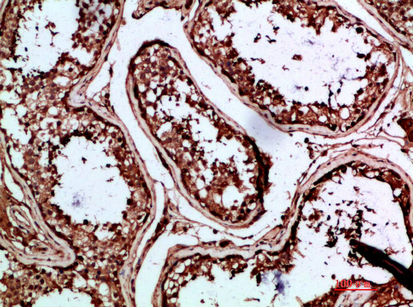
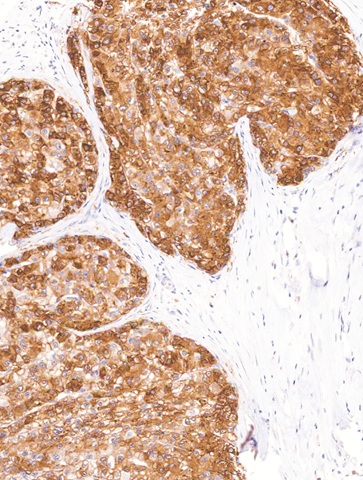
Immunohistochemical staining of human liver cancer tissue using Glutamine Synthetase Mouse Monoclonal Antibody (ARM619).
Storage
Store at 4°C short term. For long term storage, store at -20°C, avoiding freeze/thaw cycles.
Research Use Only
For Research Use Only. Not for use in diagnostic procedures.
New Products