Human CD48 ELISA Kit
 Protocol Booklet
Key features and details
- Specification:
- Sensitivity:
- Standard Curve Range:
- Standard Curve Gradient:
- Number of Incubations:
- Sample Volume:
- Assay type:
- Operation Duration:
-
Brand:

CAT.NO. : AEH0119
RMB Please choose
RMB Please choose
Size:
Trail, Bulk size or Custom requests Please contact us
*产品价格可能会有所调整,请以品牌方官网实时更新的价格为准,以确保准确性。
 Product Details
Background
CD48, also known as BLAST-1, BCM-1, and SLAMF2, is a 65 kDa GPI-linked protein in the CD2 family of immunoglobulin superfamily proteins. The mouse CD48 cDNA encodes a 240 amino acid (aa) precursor that includes a 22 aa signal sequence, a 195 aa mature protein that contains one Ig-like V-type domain and one Ig-like C2-type domain, and a 23 aa C-terminal propeptide. A soluble form of CD48 has been detected in the serum of lymphoid leukemia and arthritis patients. Mouse CD48 shares 51% and 68% aa sequence identity with human and rat CD48, respectively. It shares 18%‑26% aa sequence identity with comparable regions of mouse 2B4, BLAME, CD2F-10, CD84, CD229, CRACC, NTB-A, and SLAM. CD48 is expressed on most lineage-committed hematopoietic cells but not on hematopoietic stem cells or multipotent hematopoietic progenitors. Among dendritic cells (DC), CD48 is selectively expressed on circulating myeloid DC and resident bone marrow and thymus DC. CD2, 2B4, and heparan sulfate function as CD48 ligands. CD48 is competent to transduce signals and can also trigger signaling through CD2 or 2B4. CD48-CD2 interactions promote T cell activation and class switching to IgG2a in B cells. High affinity CD48-2B4 interactions can either promote or inhibit NK cell and cytotoxic T cell (CTL) activation. CD48-2B4 ligation does not directly trigger CTL activity but enhances signaling from the T cell receptor. CD48-2B4 mediated inhibition of NK cell activity is distinct from MHC I-restricted mechanisms. CD48 expressed on NK cells is coactivating, whereas CD48 expressed on other cell types inhibits NK cell activation (14). Both CD48 expressing and nonexpressing cells can be targets of NK cell or CTL-mediated lysis.
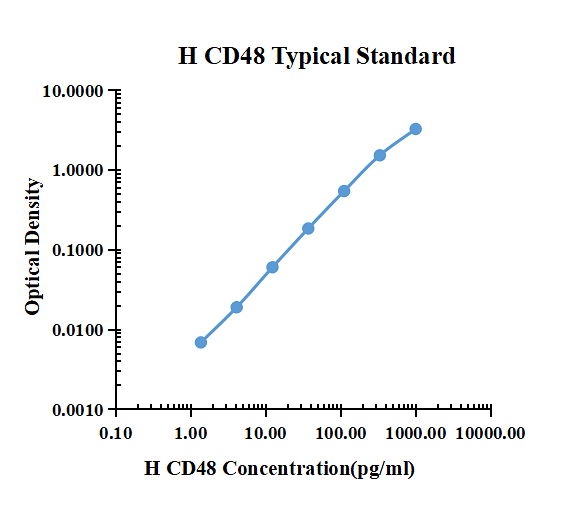
Typical data

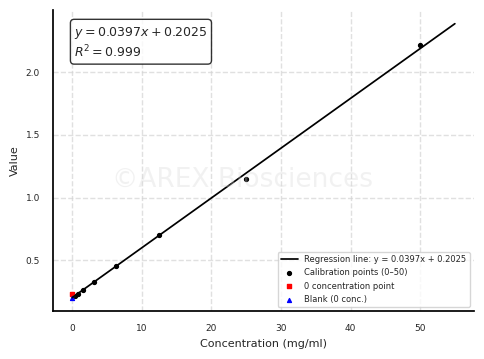
| pg/ml | O.D. | Average | Corrected | |
| 0.00 | 0.0137 | 0.0135 | 0.0136 | |
| 1.37 | 0.0207 | 0.0203 | 0.0205 | 0.0069 |
| 4.12 | 0.0328 | 0.0325 | 0.0327 | 0.0191 |
| 12.35 | 0.0735 | 0.0744 | 0.0740 | 0.0604 |
| 37.04 | 0.1995 | 0.1974 | 0.1985 | 0.1849 |
| 111.11 | 0.5747 | 0.5406 | 0.5577 | 0.5441 |
| 333.33 | 1.4730 | 1.6080 | 1.5405 | 1.5269 |
| 1000.00 | 3.3010 | 3.2540 | 3.2775 | 3.2639 |
Precision
| Item | Intra-assay Precision | Intra-assay Precision | Intra-assay Precision | Inter-assay Precision | Inter-assay Precision | Inter-assay Precision |
| Sample Number | S1 | S2 | S3 | S1 | S2 | S3 |
| 22 | 22 | 22 | 6 | 6 | 6 | |
| Average(pg/ml) | 22.9 | 105.7 | 348.3 | 22.5 | 109.1 | 338.0 |
| Standard Deviation | 0.7 | 3.3 | 12.2 | 1.0 | 3.3 | 12.2 |
| Coefficient of Variation(%) | 3.2 | 3.1 | 3.5 | 4.4 | 3.0 | 3.6 |
Inter-assay Precision (Precision between assays) Three samples of known concentration were tested six times on one plate to assess intra-assay precision.
Spike Recovery
The spike recovery was evaluated by spiking 3 levels of human IDO1 into health human serum sample. The un-spiked serum was used as blank in this experiment.
The recovery ranged from 81% to 103% with an overall mean recovery of 92%.
The recovery ranged from 81% to 103% with an overall mean recovery of 92%.
Sample Values
| Sample Matrix | Sample Evaluated | Range (pg/ml) | Detectable (%) | Mean of Detectable (pg/ml) |
| Serum | 30 | 2395.44-4374.87 | 100 | 3246.68 |
New Products