Human CTLA-4 ELISA Kit
Key features and details
- Specification:
- Sensitivity:
- Standard Curve Range:
- Standard Curve Gradient:
- Number of Incubations:
- Sample Volume:
- Assay type:
- Operation Duration:
-
Brand:

CAT.NO. : AEH0179
RMB Please choose
RMB Please choose
Size:
Trail, Bulk size or Custom requests Please contact us
 Product Details
Background
CTLA-4 (cytotoxic T-lymphocyte-4, designated CD152), is a type I transmembrane T cell inhibitory molecule that is a member of the Ig superfamily. Human or mouse CTLA-4 cDNA encodes 223 amino acids (aa) including a 35 aa signal sequence, a 126 aa extracellular domain (ECD) with one Ig-like V-type domain, a 21 aa transmembrane (TM) sequence, and a 41 aa cytoplasmic sequence. It is found as a covalent homodimer of 41‑43 kDa. Within the ECD, human CTLA-4 shares 68%, 71% and 83‑86% aa sequence identity with mouse, rat and porcine/bovine/rabbit/feline/canine CTLA-4, respectively. A 174 aa form that lacks TM and cytoplasmic sequences (sCTLA-4) is possibly secreted. Isoforms of 56‑79 aa that mainly contain parts of the cytoplasmic domain are reported. In mouse, an isoform lacking the Ig-like domain has ligand-independent inhibitory activity and is termed liCTLA-4. CD28, which is structurally related to CTLA-4, is constitutively expressed on naïve T cells and promotes T cell activation when engaged by B7-2 on antigen-presenting cells (APC) within the immunological synapse (IS). In contrast, CTLA-4 is recruited from intracellular vesicles to the IS beginning 1, 2 days after T cell activation. It forms a linear lattice with B7‑1 on APC, inducing negative regulatory signals and ending T cell activation. Abatacept, a therapeutic human CTLA-4-Ig fusion protein (trade name Orencia), competes with CD28 for B7-1 and B7-2 binding and has been used to antagonize T cell activation in autoimmune conditions and to enhance transplant survival. Mice deleted for CTLA-4 show no abnormalities until after birth, but then develop lethal autoimmune reactions due to continued T cell activation and poor control by regulatory T cells, which constitutively express CTLA-4 in wild-type mice and humans.
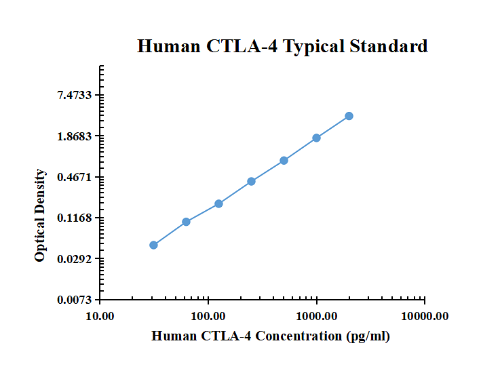
Typical data
|
pg/ml |
O.D. |
Average |
Corrected |
|
|
0.00 |
0.0105 |
0.0103 |
0.0104 |
|
|
2.74 |
0.0171 |
0.0159 |
0.0165 |
0.0061 |
|
8.23 |
0.0282 |
0.0271 |
0.0277 |
0.0173 |
|
24.69 |
0.0616 |
0.0611 |
0.0614 |
0.0510 |
|
74.07 |
0.1683 |
0.1480 |
0.1582 |
0.1478 |
|
222.22 |
0.5143 |
0.4790 |
0.4967 |
0.4863 |
|
666.67 |
1.5540 |
1.5790 |
1.5665 |
1.5561 |
|
2000.00 |
3.9590 |
3.9100 |
3.9345 |
3.9241 |
Precision
|
Intra-assay Precision |
Inter-assay Precision |
|||||
|
Sample Number |
S1 |
S2 |
S3 |
S1 |
S2 |
S3 |
|
22 |
22 |
22 |
6 |
6 |
6 |
|
|
Average(pg/ml) |
53.1 |
266.2 |
814.9 |
17.2 |
77.5 |
231.4 |
|
Standard Deviation |
2.9 |
9.1 |
34.8 |
1.3 |
5.1 |
12.0 |
|
Coefficient of Variation(%) |
5.5 |
3.4 |
4.3 |
7.8 |
6.6 |
5.2 |
Inter-assay Precision (Precision between assays) Three samples of known concentration were tested six times on one plate to assess intra-assay precision.
Spike Recovery
The spike recovery was evaluated by spiking 3 levels of human CTLA-4 into health human serum sample. The un-spiked serum was used as blank in this experiment.
The recovery ranged from 91% to 97% with an overall mean recovery of 94%.
The recovery ranged from 91% to 97% with an overall mean recovery of 94%.
Sample Values
| Sample Matrix | Sample Evaluated | Range (pg/ml) | Detectable (%) | Mean of Detectable (pg/ml) |
|---|---|---|---|---|
| Serum | 30 | 0.31-3.78 | 100 | 1.11 |
Serum/Plasma – Thirty samples from apparently healthy volunteers were evaluated for the presence of CTLA-4 in this assay. No medical histories were available for the donors.
New Products