Human IL-1RA/IL-1F3 ELISA Kit

Key features and details
- Specification:
- Sensitivity:
- Standard Curve Range:
- Standard Curve Gradient:
- Number of Incubations:
- Sample Volume:
- Assay type:
- Operation Duration:
-
Brand:

 Product Details
Interleukin-1 receptor antagonist (IL-1ra; also known as IL-1F3) is a 22-25 kDa member of the IL-1 family of cytokines. Currently, there are 11 family members (IL-1F1-F11), nine of which form an IL-1 gene cluster on human Ch2. Each IL-1 family member contains an IL-1 fold. This fold is generated by 12 packed beta -sheets that interact to form a beta -trefoil structure. Little amino acid (aa) homology is required to achieve this structure, and this explains the low aa identity among IL-1 family members. IL-1ra is a pure cytokine receptor antagonist that has no signal transduction-initiating activity. It is an acute phase protein that exists to dampen inflammation. IL-1( beta ) is initially produced by monocytes in response to a variety of stimuli. Circulating IL-1 then binds to widely expressed IL-1 type I receptors (IL-1 RI) and initiates a number of pro-inflammatory events. On endothelial cells (EC), IL-1 induces PGE2 and IL-6 release, generating fever, thrombocytosis, and hepatic acute phase protein production. In synovial joints, IL-1 induces chondrocyte NO production, an event that leads to reduced collagen synthesis and chondrocyte apoptosis. Finally, IL-1 increases neutrophil counts, both in blood and tissue, and thus is able to promote a pro-inflammatory environment in multiple locations. IL-1ra blocks IL-1 action through competitive inhibition. More correctly, although IL-1ra fills the IL-1 binding site in IL-1 RI, it is also unable to orchestrate the creation of a signal-transducing IL-1 RI:IL-1 R Accessory protein (IL-1 R AcP) heterodimer complex. Effective IL-1ra concentrations are generally 100-fold greater than local IL-1 concentrations. This is because the IL-1ra half-life is but 6 minutes, and very few IL-1 type I receptors need to be engaged by IL-1 to elicit a cellular response.
Human IL-1ra is synthesized as a 177 aa precursor that contains a 25 aa signal sequence and a 152 aa mature region. Although it contains an IL-1 cytokine fold, it apparently lacks two structural motifs that allow for activation of the IL-1 receptor heterodimer. First, and following binding to IL-1 RI, the presence of Ile 51-His 54 and Lys 145 of the mature molecule preclude recruitment of IL-1 R AcP. Second, there is no identifiable C-terminal lectin segment that is hypothesized to help recruit an accessory signaling component. Mature human IL-1ra is 77% and 82% aa identical to mouse and canine IL-1ra, respectively, and human IL-1ra inhibits IL-1 activity on mouse cells. A number of cell types express IL-1ra, including monocytes, Sertoli cells, hepatocytes, adipocytes, synovial fibroblasts, mast cells, pancreatic beta -cells, and intestinal epithelial cells. There are at least three intracellular IL-1ra isoforms (icIL-1ra1, 2, and 3). All show N-terminal variation, and all contain amino acids 35-177 of the secreted precursor. Intracellular IL-1ra1 is of particular interest, because it is reported to be "secreted" by endothelial cells and binds to the IL-1 RI in an antagonist fashion. Intracellular IL-1ra1 is 159 aa in length and shows a 3 aa substitution for the first 21 aa's of the signal sequence of IL-1ra.
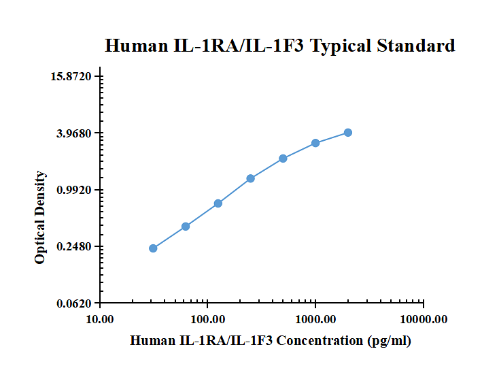
|
pg/ml |
O.D. |
Average |
Corrected |
|
|
0.00 |
0.0625 |
0.0611 |
0.0618 |
|
|
2.74 |
0.0946 |
0.1014 |
0.0980 |
0.0362 |
|
8.23 |
0.1404 |
0.1366 |
0.1385 |
0.0767 |
|
24.69 |
0.2081 |
0.1979 |
0.2030 |
0.1412 |
|
74.07 |
0.3790 |
0.3737 |
0.3764 |
0.3146 |
|
222.22 |
0.9861 |
0.9935 |
0.9898 |
0.9280 |
|
666.67 |
2.1300 |
2.1710 |
2.1505 |
2.0887 |
|
2000.00 |
3.6470 |
3.7770 |
3.7120 |
3.6502 |
|
Intra-assay Precision |
Inter-assay Precision |
|||||
|
Sample Number |
S1 |
S2 |
S3 |
S1 |
S2 |
S3 |
|
22 |
22 |
22 |
6 |
6 |
6 |
|
|
Average(pg/ml) |
37.9 |
190.5 |
584.1 |
42.1 |
208.8 |
611.7 |
|
Standard Deviation |
2.8 |
12.1 |
37.9 |
1.9 |
14.5 |
41.6 |
|
Coefficient of Variation(%) |
7.4 |
6.3 |
6.5 |
5.3 |
4.2 |
4.6 |
Inter-assay Precision (Precision between assays) Three samples of known concentration were tested six times on one plate to assess intra-assay precision.
The recovery ranged from 85% to 109% with an overall mean recovery of 98%.
| Sample Matrix | Sample Evaluated | Range (ng/ml) | Detectable (%) | Mean of Detectable (ng/ml) |
|---|---|---|---|---|
| Serum | 30 | 6.34-126.18 | 100 | 33.78 |
Serum/Plasma – Thirty samples from apparently healthy volunteers were evaluated for the presence of IL-1RA in this assay. No medical histories were available for the donors.
New Products