Human MMP-3 ELISA Kit
Key features and details
- Specification:
- Sensitivity:
- Standard Curve Range:
- Standard Curve Gradient:
- Number of Incubations:
- Sample Volume:
- Assay type:
- Operation Duration:
-
Brand:

 Product Details
Matrix metalloproteinases (MMPs), also called matrixins, constitute a family of zinc and calcium dependent endopeptidases that function in the breakdown of extracellular matrix (ECM). They play an important role in many normal physiological processes such as embryonic development, morphogenesis, reproduction and tissue remodeling. They also participate in many pathological processes such as arthritis, cancer and cardiovascular disease. While the amounts of newly synthesized MMPs are regulated mainly at the levels of transcription, the proteolytic activities of existing MMPs are controlled through both the activation of proenzymes or zymogens and the inhibition of active enzymes by endogenous inhibitors, alpha -macroglobulins and tissue inhibitors of metalloproteinases (TIMPs).
MMP-3 (also referred to as stromelysin-1) may be expressed in fibroblasts, chondrocytes, endothelial cells, macrophages, vascular smooth muscle cells, osteoblasts, and keratinocytes in response to appropriate stimuli. Various agents regulate its biosynthesis. Inflammatory cytokines such as IL-1 and TNF-alpha, epidermal growth factor, platelet-derived growth factor, phorbol and oncogenic cellular transformation are the inductive agents. In comparison, retinoic acid, glucocorticoids, estrogen, progesterone and TGF-beta suppress MMP-3 synthesis.
MMP-3 is secreted from the cells as a proenzyme. The proenzyme has been shown to stimulate plasminogen activation. The N-terminal pro-domain contains the cysteine switch motif conserved in MMPs that maintains MMP-3 in the latent state. Activation of the proenzyme results in the removal of the pro-domain. MMP-3 activation can be achieved in vitro by proteases such as itself, chyrotrypsin, neutrophil elastase and plasma kallikrein, and by mercury compounds. The resulting active enzyme consists of a catalytic domain with a zinc-binding motif conserved in metzincins. A short hinge peptide links the catalytic domain to the C-terminal hemopexin-like domain. The active MMP-3 is capable of cleaving types III, IV, IX and X collagen, aggrecan, fibronectin, laminin, IGFBP-3, serpins, and IL-1 beta. The active enzyme also activates proMMP-1, -8, -9, and -13. Therefore, it is suggested that MMP-3 may participate in physiological matrix turnover and pathological destruction of the tissue. For example, MMP-3 is required for the generation of a macrophage chemoattractant in a model of herniated disc resorption.
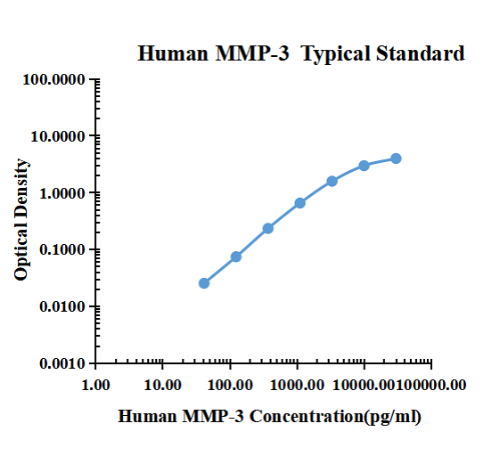
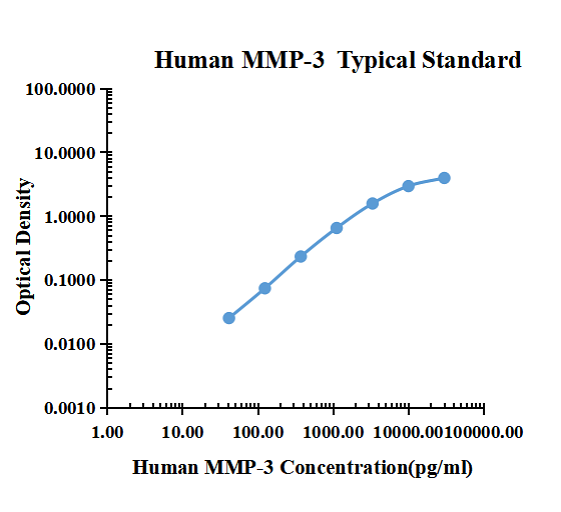
|
pg/ml |
O.D. |
Average |
Corrected |
|
|
0.00 |
0.0080 |
0.0084 |
0.0082 |
|
|
41.15 |
0.0319 |
0.0354 |
0.0337 |
0.0255 |
|
123.46 |
0.0831 |
0.0823 |
0.0827 |
0.0745 |
|
370.37 |
0.2282 |
0.2572 |
0.2427 |
0.2345 |
|
1111.11 |
0.6496 |
0.6786 |
0.6641 |
0.6559 |
|
3333.33 |
1.5680 |
1.6220 |
1.5950 |
1.5868 |
|
10000.00 |
2.9370 |
3.0260 |
2.9815 |
2.9733 |
|
30000.00 |
3.9709 |
4.0157 |
3.9933 |
3.9851 |
|
Intra-assay Precision |
Inter-assay Precision |
|||||
|
Sample Number |
S1 |
S2 |
S3 |
S1 |
S2 |
S3 |
|
22 |
22 |
22 |
6 |
6 |
6 |
|
|
Average(pg/ml) |
653.3 |
3162.9 |
11055.8 |
601.2 |
3117.6 |
9789.5 |
|
Standard Deviation |
42.4 |
205.0 |
754.4 |
23.4 |
196.2 |
309.7 |
|
Coefficient of Variation(%) |
6.5 |
6.5 |
6.8 |
3.9 |
6.3 |
3.2 |
Inter-assay Precision (Precision between assays) Three samples of known concentration were tested six times on one plate to assess intra-assay precision.
| Sample Matrix | Sample Evaluated | Range (ng/ml) | Detectable (%) | Mean of Detectable (ng/ml) |
|---|---|---|---|---|
| Serum | 30 | 1.47-24.25 | 100 | 9.95 |
New Products