pTau217 Mouse Monoclonal Antibody(ARA980)
Key features and details
- Reactivity:Human
- Application:Sandwich ELISA
- Host:Mouse
- Clonality:Monoclonal
- lsotype:IgG1
- Target:pTau217
-
Brand:

CAT.NO. : ARA6846
RMB Please choose
RMB Please choose
 Product Details
Background
Promotes microtubule assembly and stability, and might be involved in the establishment and maintenance of neuronal polarity. The C-terminus binds axonal microtubules while the N-terminus binds neural plasma membrane components, suggesting that tau functions as a linker protein between both. Axonal polarity is predetermined by TAU/MAPT localization (in the neuronal cell) in the domain of the cell body defined by the centrosome. The short isoforms allow plasticity of the cytoskeleton whereas the longer isoforms may preferentially play a role in its stabilization.
Application
|
Application |
Dilution Ratio |
|
Sandwich ELISA |
1:250 - 1:500 |
Overview
|
Antibody Specificity |
Recognizing pTau with the epitope containing phosphorylated T217 |
|
Species Reactivity |
Human |
|
Clonality |
Monoclonal |
|
Host / Isotype |
Mouse / IgG1 |
|
Immunogen |
Synthetic peptide within aa200-250 of Tau. The exact peptide sequence is proprietary information |
|
Cross Reactivity |
Not tested |
|
Recombinant |
Not recombinant |
|
Purification |
Protein A purification |
|
Form |
Liquid |
|
Conjugation |
Unconjugated |
Data
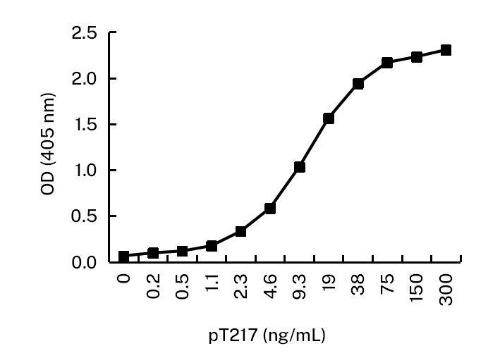
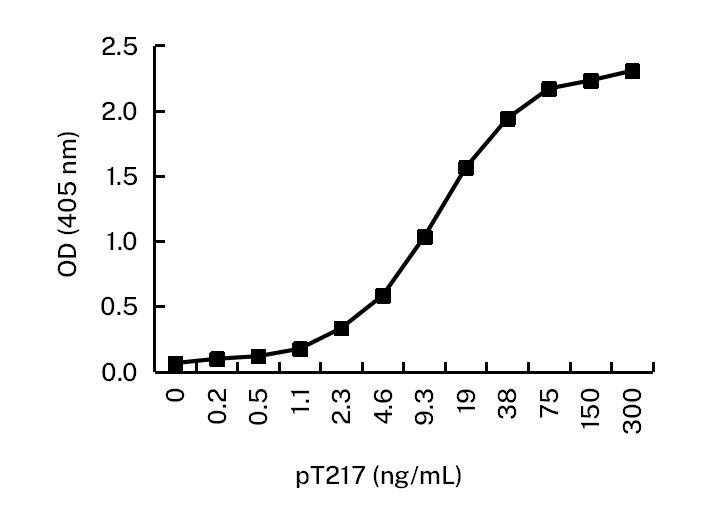
Sandwich ELISA analysis of pTau217 by ARA6846 & ARA6837.
Microtiter wells were coated with ARA6846 as the capture antibody. Human Tau (phospho T217) was used as the antigen. Peroxidase conjugated mouse anti-human Tau monoclonal antibody (ARA6837) was used as the detection antibody.
Result: ARA6846 and ARA6837 can be used as a matched antibody pair to detect and quantify the concentration of pTau217.
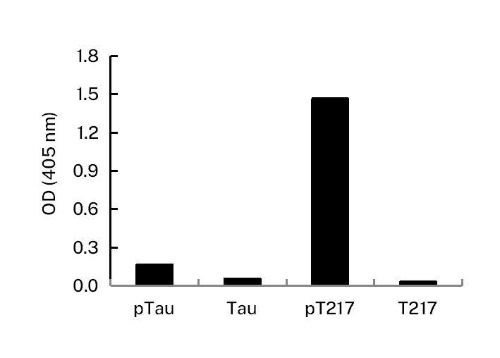
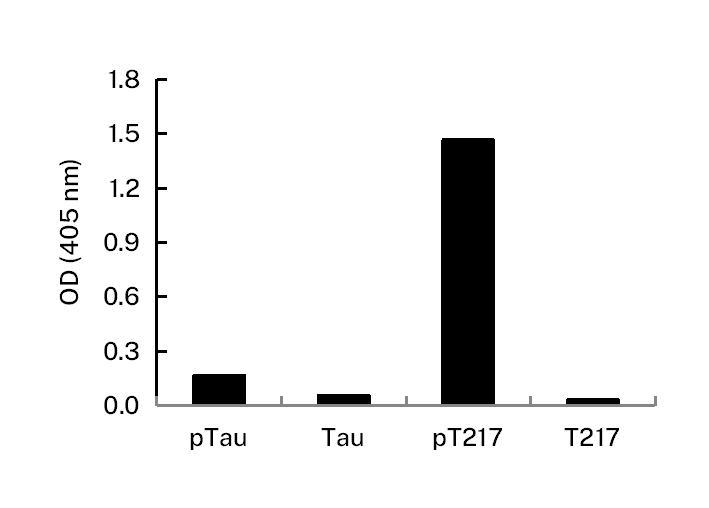
Cross reactivity of ARA6846 to other peptides and recombinant proteins by ELISA.
Microtiter wells were coated with various peptides and recombinant proteins.
ARA6846 was used as the primary antibody and peroxidase conjugated goat anti-mouse IgG was used as the secondary antibody.
Result: ARA6846 recognized pTau protein with the epitope containing phosphorylated T217.
Storage
Store at +4℃ after thawing. Aliquot store at -20℃. Avoid repeated freeze / thaw cycles.
Research Use Only
For Research Use Only. Not for use in diagnostic procedures.
New Products